
Baku’s Public Transport and Micromobility Infrastructure Highlighted as an Example in ITF Report
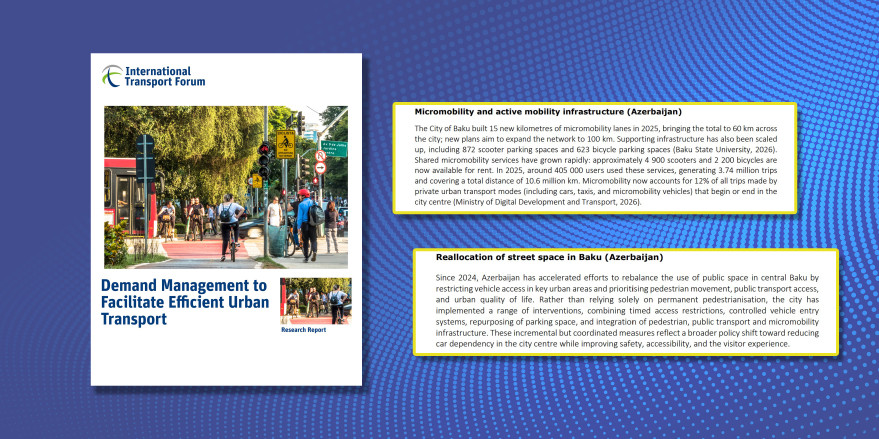
Baku’s micromobility infrastructure and the city’s efforts to redesign urban spaces to make them more accessible and convenient for pedestrians have been highlighted as a specific example in the International Transport Forum (ITF) report titled Demand Management to Facilitate Efficient Urban Transport.
The report notes that 15 kilometres of new micromobility lanes were established in Baku in 2025, bringing the total length of the network to 60 kilometres. At the next stage, this figure is expected to increase to 100 kilometres. At the same time, parking spaces for 872 scooters and 623 bicycles have been created across the city.
Rental services are also expanding rapidly. According to the report, approximately 4,900 scooters and 2,200 bicycles are available for rent in Baku. In 2025, approximately 405,000 users made 3.74 million trips, covering a total distance of 10.6 million kilometres. Micromobility accounts for 12% of personal transport trips originating or ending in the city center, when cars, taxis and micromobility are considered together.
The report also notes the adoption of new national standards for sidewalks and pedestrian paths in Azerbaijan as an indication of greater attention to pedestrian accessibility.
New Pedestrian Zones and Controlled-Access Systems
The report’s section titled Redistributing Street Space in Baku states that, since 2024, efforts to restrict vehicle access and give priority to pedestrians and public transport in the city center have accelerated. This does not simply mean fully pedestrianizing streets; rather, it encompasses a range of measures, including time-based access restrictions, controlled-access systems, the repurposing of parking spaces, and better coordination between different modes of transport.
Examples of these measures include the temporary pedestrian zones established around Khagani Garden on weekends, restrictions on vehicle access to Icherisheher and Aziz Aliyev Street, and the provision of designated parking spaces for tourist buses outside the historic center. However, access has been maintained for residents, people working in the area and service vehicles.
The report also covers the changes implemented in the area in front of Baku Railway Station and the “28 May” metro station. The area is considered one of the city’s busiest transport hubs. Vehicle traffic and parking have been restricted, while the former parking areas have been converted into controlled zones for passenger pick-up and drop-off.
The ITF has assessed these measures as delivering tangible results in terms of improving accessibility, reducing congestion and decreasing car dependency.
114 Kilometres of New Bus Lanes and the “Digital Twin” Model
The report highlights the 114 kilometres of new bus lanes introduced in Baku over the past four years as an international example of priority bus lanes. It notes that the measure is aimed at improving the reliability and frequency of bus services, reducing congestion and enhancing the safety of vulnerable road users.
In the section on the assessment of transport projects, Baku’s “Digital Twin” transport model is presented as an example of advanced practice. It is noted that the model has been used to assess and compare alternative solutions for more than 20 transport projects, including the expansion of metro infrastructure.
The ITF’s observations reflect the international recognition of Azerbaijan’s comprehensive reforms in urban transport management, financing and digital planning.