
Strengthening Children’s Safety in the Digital Environment: What Do the Amendments Cover?
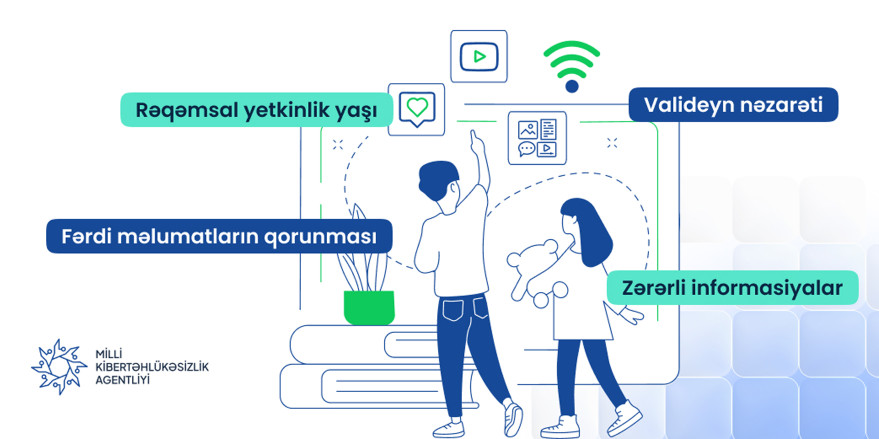
A draft law proposing amendments to the Code of Administrative Offences and the Laws of the Republic of Azerbaijan “On Information, Informatization and Protection of Information” and “On the Protection of Children from Harmful Information” aims to strengthen the safety of children on social media platforms and provide more effective protection against harmful influences in the digital environment.
The draft law has been prepared to implement the Order of the President of the Republic of Azerbaijan entitled “On Measures to Protect Children from Harmful Content and Influences in the Digital Environment”.
During the preparation of the draft law, international best practices were examined, with particular attention given to the legislative models of countries that have advanced mechanisms for ensuring digital safety. In this context, the minimum age for opening personal digital accounts on social media platforms has been set at 16.
Taking into account that, under the Law of the Republic of Azerbaijan “On the Protection of Children from Harmful Information,” persons aged 16 to 18 are classified as children, the draft law also provides for additional safeguards for this age group in the digital environment. Accordingly, persons aged 16 to 18 will be permitted to create and use personal digital accounts on social media platforms and share content only with the consent and under the supervision of their legal representatives.
Platform providers will be required to implement effective technical measures to verify compliance with the minimum age requirement. Initial verification mechanisms will include the verification of information associated with a bank card, email address, and mobile phone number to confirm the user’s age and, where applicable, obtain the consent of the legal representatives of persons aged 16 to 18. In addition, other technical methods for determining a person’s age when creating a personal digital account may be used, subject to the joint approval of the relevant state authorities.
The content and advertisements that may be displayed to users aged 16 to 18, as well as the hours during which they may access the platform, will be managed by their legal representatives. To this end, platform providers will be required to provide appropriate parental control functionality. Platform providers will also be required to regularly analyse user behaviour and, where there are reasonable grounds to doubt a user’s declared age, conduct repeat age verification.
The draft law places particular emphasis on the protection of personal data. Personal data collected for the purpose of age verification may not be stored in information systems, transferred to third parties, or used for commercial purposes or targeted advertising. In addition, platform providers will be required to ensure that a user’s profile and any information posted by the user are completely deleted from their systems before the user reaches the age of majority.
The draft law also introduces additional technical and security measures to protect the mental and physical well-being of children. In particular, the default privacy settings for the accounts of users aged 16 to 18 must be set to the highest level, the public disclosure of location data must be restricted, and an enhanced security mode must be provided in accordance with the user’s preferences.
The draft law also prohibits the use of manipulative design techniques that encourage addictive behaviour among children, including infinite scroll and autoplay features, as well as the placement of harmful content and advertisements.
The new requirements will not apply to all social media platforms. Platforms that facilitate educational, healthcare, or professional and business interactions are exempt from these requirements.
The draft law also proposes the state registration of platform providers offering services to users in the Republic of Azerbaijan. It also provides for the application of progressive financial sanctions, advertising restrictions, and measures to restrict internet traffic in respect of platforms that fail to obtain state registration.