
Azerbaijan’s Transit Potential Strengthens as Freight Volumes Reach Record Levels
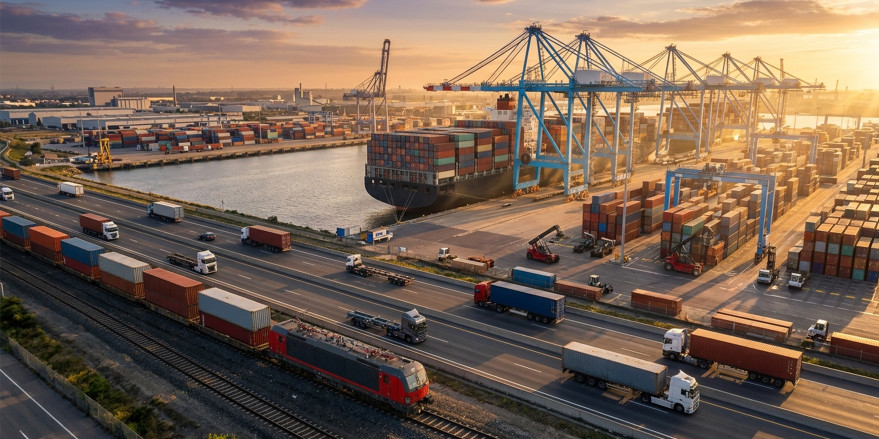
Azerbaijan is expanding its role as an international transport and logistics hub. As a result of the development of the East–West and North–South international transport corridors, alongside major infrastructure projects implemented in recent years, transit freight volumes exceeded 12 million tonnes in the first nine months of 2026, reaching their highest level in five years. This represents a 14.5% increase compared with the same period last year. Transit freight volumes recorded particularly strong growth along the East–West route, rising by 20.2%, while the North–South route saw an increase of 19.0%.
Positive growth was also recorded in port operations. In the first nine months of this year, container throughput increased by 29% year-on-year to 100,000 TEU, while dry cargo throughput rose by 71% to 1.73 million tonnes.
The positive trend in transit freight volumes reflects efforts to develop transport and logistics infrastructure, advance digitalisation, strengthen coordination among relevant authorities to improve operational efficiency, and expand international cooperation. At the same time, changes in global trade routes have contributed to increased demand for Azerbaijan’s transit capacity. These efforts have also helped accelerate freight transportation along the Middle Corridor and enhance the route’s competitiveness.
Development of Transport Infrastructure
In recent years, a number of large-scale projects have been implemented to develop Azerbaijan’s railway, road, maritime and air transport infrastructure and enhance the country’s transit capacity and competitiveness along international transport corridors.
As part of these efforts, the Baku–Tbilisi–Kars railway line, a key component of the Middle Corridor, has been modernized, bringing its annual freight capacity to 5 million tonnes.
The infrastructure of the Baku International Sea Trade Port, which plays a key role in enhancing the competitiveness of the Middle Corridor, has also been expanded. In recent years, the port’s annual container handling capacity has increased from 100,000 TEU to 160,000 TEU. Improvements in operational coordination have reduced vessel turnaround times from approximately 20 hours to 4–5 hours.
The port currently has an annual cargo handling capacity of 15 million tonnes. Under the ongoing expansion project, this is expected to increase to 25 million tonnes, while annual container handling capacity is projected to rise to 500,000 TEU.
Another major project being undertaken as part of the development of the Alat transport and logistics hub is the construction of a cargo airport. As part of a multimodal logistics complex integrating maritime, rail, road and air transport, the new airport will help improve cargo handling efficiency and enhance the capacity of the Middle Corridor.
Major projects are also under way to expand the maritime fleet to accommodate growing freight volumes across the Caspian Sea. Construction of four cargo vessels is ongoing at Baku Shipyard under the company’s first international commercial order. In addition, on 16 September 2025, Baku Shipyard LLC and AD Ports Group signed a contract for the construction of two container ships, each with a capacity of 780 TEU.
At the same time, the construction of high-capacity ferries, the expansion of Ro-Ro services, initiatives undertaken in cooperation with the private sector, and the gradual renewal of the fleet are aimed at increasing the capacity of the Caspian Sea crossing and strengthening the resilience of freight transport along the Middle Corridor.
Development of the Zangazur Corridor and New Transport Links
The development of the Zangazur Corridor is of particular importance for expanding Azerbaijan’s transit capacity and diversifying international transport routes. In this regard, construction of the Horadiz–Aghband highway has been completed, while work on the railway line is ongoing. Efforts are also under way to modernise Nakhchivan’s railway infrastructure. The development of the Zangazur Corridor is expected to provide additional freight transport capacity of up to 15 million tonnes per year, thereby strengthening regional transport connectivity.
Improving Border-Crossing Efficiency
To improve the efficiency of transit freight transport, border-crossing infrastructure is being modernised, customs procedures are being simplified, and information exchange between government agencies is being enhanced.
Azerbaijan has 12 operational border-crossing points open to road traffic, with a combined daily throughput capacity of 4,350 vehicles in one direction.
In recent years, the modular border crossing point of Khanoba on the Azerbaijan–Russia border and that of Astara on the Azerbaijan–Iran border have been commissioned.
These measures help improve the management of traffic flows at border crossings and enhance the competitiveness of international transport corridors.
Digital Transformation in Transport
One of the key priorities in improving the efficiency of transit freight transport is the digitalisation of transport and logistics processes. The Single Window Information System – Digital Logistics Platform, developed by the Ministry of Digital Development and Transport, represents an important step in this direction. The platform speeds up document processing, simplifies procedures and creates a more agile logistics ecosystem for businesses. The next phase envisages integrating the platform with similar systems in partner countries along the Middle Corridor, further enhancing efficiency across the route.
In parallel, the Ministry of Digital Development and Transport, in cooperation with international partners, is working towards the phased introduction of modern digital transport tools, including e-CMR, e-Permit and the e-CIM/SMGS electronic consignment note system. The introduction of these tools will expand the use of paperless technologies in international freight transport and facilitate the more efficient exchange of transport data among stakeholders along international transport corridors.
Improving the Legal and Institutional Framework
A number of bilateral and multilateral roadmaps, agreements and memoranda of understanding have been signed to coordinate joint infrastructure projects, develop transport connectivity and improve the efficiency of freight transport.
On 15 October 2026, Azerbaijan and Kazakhstan signed an Agreement on Cooperation for the Development of the Middle Corridor. The document marks an important step towards the further development and institutional strengthening of the Middle Corridor and lays the groundwork for other participating countries to join this cooperation framework. Efforts are currently under way to enable other countries to accede to the Agreement.
The Contribution of Transit Potential to Sustainable Development
The growth in transit freight volumes contributes not only to the development of the transport sector, but also to value creation in the non-oil economy and the expansion of economic activity. Strengthening Azerbaijan’s transit potential reinforces the country’s position in global supply chains, enhances its investment attractiveness and promotes regional economic integration. The measures taken in this area create significant opportunities for Azerbaijan to evolve from a transit and logistics hub into a regional economic hub, diversify its non-oil economy and achieve sustainable long-term economic growth.